
W. J. Gooding
Service no. 31983
Private, Welsh Regiment, 19th (Pioneer) Battalion
Killed in action age 19 on 25 February 1917
CWGC: “Brother of Harry I. Gooding, of “Clevedon,” Papworth Everard, Cambridge.”
Remembered at Bard Cottage Cemetery, Ypres, Belgium
Arthur Laurence Gooding
A. L. Gooding
Information from Soldiers Died in the Great War and Ireland’s Memorial Records, 1914-1918
Service no. 42122
Formerly 34611, K.R.R.C.
Rifleman, Royal Irish Rifles
Killed in action 7 June 1917
Jesse William Goff

P. W. Goff (erroneously given for J.W. Goff)
Service no. 300319
Rifleman, London Regiment (London Rifle Brigade), 1st/5th Battalion
Born in Clapham; enlisted in London; lived in Clapham
Killed in action on 1 July 1916 (the first day of the battle of the Somme), aged 19
Remembered at Thiepval Memorial, Somme, France
Jesse William Goff is consistently misnamed as P.W. (Percy William Goff) – in his Army records, on his medals cards, in the Commonwealth War Graves Commission database, on the Thiepval Memorial and at Stockwell War Memorial. Why this should be is still a mystery to his descendants. The family have his medals and death plaque – they give his Army number so there is no question that this is the correct man.
Information from the 1911 census
In 1911 the Goff family lived at 63 Chelsham Road, Clapham, where they had seven rooms. Jesse William Goff, then 13 and an only child, lived with his father, William Percy Goff, 43, a prudential assurance agent from Poole, Dorset, and Grace Mary Goff, 38, an assistant mistress at a London County Council school. There was a boarder, Frank Cutten, 28, a compositor from Chichester, Sussex.
Sue and Ron Falder have sent the photo of Jess, above, and the text of two letters he wrote to his Aunt “Op” (Annie Margaret Carroll (nee Williams) Jesse’s mother’s sister, who is Sue Falder’s grandmother, at 42 Risingholme Road, Weald Village, Harrow, Middlesex.
They provide a vivid portrait of the hard work required at the front, and of the dry good humour life there brought to the surface. He sounds both hard-working (“hard work and fresh air”) and sweet-natured in his expressions of affection for his young cousin Molly and the newborn baby.
The first letter is dated 28 May (1916). He mentions the fact that Jim (Op’s husband) may be called up. By January 1916 compulsory conscription was in place. It applied to unmarried or widowed men between 18 and 41, but on 25 May 1916 married men were included. Those in trades that were considered vital to the war economy – the so-called “starred occupations” – were exempt. I am not sure who “our boss” mentioned in the letter is, but it could be Jess’s sardonic description of his own mother.
Sue and Ron Falder have sent the photo of Jess, above, and the text of two letters he wrote to his Aunt “Op” (Annie Margaret Carroll (nee Williams) Jesse’s mother’s sister, who is Sue Falder’s grandmother, at 42 Risingholme Road, Weald Village, Harrow, Middlesex.
They provide a vivid portrait of the hard work required at the front, and of the dry good humour life there brought to the surface. He sounds both hard-working (“hard work and fresh air”) and sweet-natured in his expressions of affection for his young cousin Molly and the newborn baby.
The first letter is dated 28 May (1916). He mentions the fact that Jim (Op’s husband) may be called up. By January 1916 compulsory conscription was in place. It applied to unmarried or widowed men between 18 and 41, but on 25 May 1916 married men were included. Those in trades that were considered vital to the war economy – the so-called “starred occupations” – were exempt. I am not sure who “our boss” mentioned in the letter is, but it could be Jess’s sardonic description of his own mother.
My Dear Op,
I have just got your address from Ma.
I was going to write before but I could not remember the name of your street. I remembered the number of the house that was all.
Well I am out here again & very near where I was before in fact we pass some of our old billets daily.
It is rather warmer than before in more ways than one. Nevertheless by dint of hard work & fresh air we manage to keep ourselves alive & fit. Mind you it’s not all cakes & ale but our various little “grouses” would fill a book.
We go out & work every day with picks & shovels just like navvies (the only difference is that the latter get about three times the pay). Sometimes we get a little shelling or “strafing” sometimes not, usually the former but we have managed without any casualties so far. Our week usually consists of seven days (working) & after a lengthy discussion today we have come to the conclusion that the man who could put forward an invention that would get another 24 hrs out of a week, would make his fortune.I have heard from Ma about Uncle “Jim” & the “garrison duty abroad” business. Really I should not think that he would be called up at all. I’m sure I don’t know how our “boss” will get on if the age limit extends much more. But I must not express my own views on the subject as this epistle has to pass through other hands.
“Let’s” hope it will be all over soon.
Shall be pleased to hear from you when you can spare the time. Hope you are all well: I am quite fit. Love to both of you. Lot’s of kisses for Molly and I can only say “the other”. I do not know the name or sex.
Anyhow just mention that “he or she” has got a cousin.
Yr Loving Nephew, Jess.
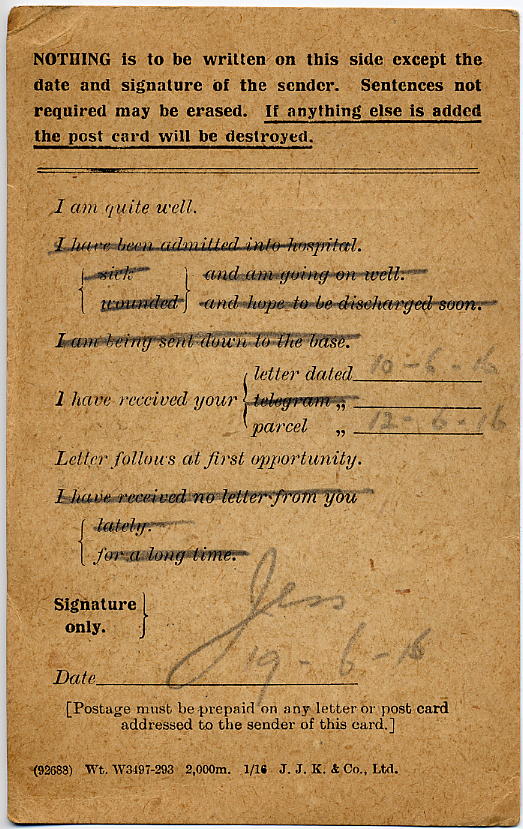
The second letter was written on Friday 23 June, just a few days before he was killed, on 1 July 1916. He mentions the “official P.C. [postcard]”, shown left.
My dear Op & Jim
Thanks very much for your letter and parcel. Many of us enjoyed the contents. As a matter of fact it arrived at a most opportune moment – we were in the trenches.
That is the reason I was unable to write there and then, but I hope you received the official p.c.
We had a rather rough time up there but are very now resting (& very glad too).
Really there is next door to no news. One cannot say everything & – well all that remains is I am quite well and the weather has not been at all good.
We see rather more life & more grub now since we have left the “navvies”. I don’t think anyone was very sorry to leave.
By the way I’m afraid I’m putting the cart before the horse. I don’t think I told you that we moved and are now with our regiment.
My address for the future will be No. 255 A Coy. London Rifle Brigade B.E.F. France.
Now I’m afraid that is all.
Best of love to Molly & the new arrival.
Y. Loving Nephew Jess
George Harry Glover
G. H. Glover
Service no. 11773
Private, Border Regiment, 2nd Battalion
Died of wounds age 20 on 31 March 1915
Born in Lambeth; enlisted in London; lived in Stockwell
CWGC: “Son of George Harry and Mary Jane Glover, of Stockwell, London.”
Remembered at Wimereux Communal Cemetery, France
At six foot two, George Harry Glover was one the tallest of the men on the Stockwell War Memorial. He would have towered over most of his fellow soldiers. He was well built too, for the time. 140 pounds, with a 36 inch chest which he could expand by 2 inches. Hazel eyes, brown hair and fresh complexion, complete a picture of an attractive, fit and healthy young man. He enlisted early in the war – 4 September 1914 – at the age of 20. Before the war, Glover was a furniture salesman. He had spent 2½ years in the National Naval Cadets (Wandsworth Battalion) and was discharged in 1910.
Glover was on the home front until 16 February 1915, joining the British Expeditionary Force on 17 February. He lasted just over a month on the Western Front, and after only 210 days as a British soldier succumbed to a gunshot wound to the shoulder sustained on 15 March 1915. After transferring to a hospital in Boulogne, he was deemed on 22 March he was deemed to be “improving”, but he died on 31 March.
His effects, sent to his parents, included
2 leather purses
1 keyring
5 keys
1 chain
1 watch key – broken
I combination ?
1 cigarette case containing 7 cigarettes
1 Gospel acc St John
4 letters
6 postcards
3 photos
Other items are unreadable – the records are badly damaged.
On 3 April 1915 Glover’s mother, Mary Jane, wrote to the Officer in Charge at the Record Office in Preston from her home at 19 Hargwyne Street, Stockwell, London SW:
Sir
I beg to ask if you can give me any information as to the whereabouts of Private G. H. Glover, No 11773, A Company, 2nd Batt. Border Regt, with the Expeditionary Force…
The rest of the letter is missing, but on 11 April Mary Jane wrote again:
With reference to your letter No 19550/17 of 6th April 1915 addressed to Mr Lee I wrote on behalf of my son death. He died died of wounds 31st March. Private George Glover 11773 of the Border Regt. I beg most respectfully to ask as I am his mother would you kindly say when I can have any further news regarding his death. I am sir your Obediant Servant M. J. Glover
The letter has all the appearance of having been written through tears. Even allowing for the damage to the original document, her expressions are garbled.
The army replied on 16 April: “If you write to the Officer in Charge of the hospital where your son died giving his Regiment, full name, Regiment [sic] and date of death they may be able to give some further information.”
Her son was buried at Wimereux Communal Cemetery, Grave No 303.
Ernest Girdlestone
E. Girdlestone
Service no. 16374
Private, Oxford and Bucks Light Infantry, 6th Battalion
Killed in action age 38 on 17 September 1916
Enlisted in Lambeth; lived in Brixton
CWGC: “Son of the late Owen William and Clara Morten Girdlestone, brother of Mrs. L. Boughey, of 283 Rosendale Road, Herne Hill, London.”
Remembered at London Cemetery and Extension, Longueval, France
Information from the censuses
In 1911 Ernest Arthur Girdlestone, 30, was working as a painter’s labourer and living with his brother Percy James Girdlestone, 28, a widowed upholsterer, and his son, William Girdlestone, 6, at 188 Icknield Port Road, Birmingham, where they occupied 2 rooms. All were born in Brixton, south-west London.
Twenty years earlier Ernest was living with his parents and siblings at 99 Stockwell Road, where the household included:
Owen Girdlestone, 63, an upholsterer from Halesworth, Suffolk
Clara Girdlestone, 44, from Colchester, Essex
Owen Girdlestone, 16, a tailor’s porter, born in Holborn, London
Ernest Girdlestone, 13, born in Holborn, London
Percy Girdlestone, 12, born in Holborn, London, “speech and hearing imperfect”
Clara Girdlestone, 2, born in Lambeth
There is a discrepancy between the 1891 and 1911 censuses in place of birth for Ernest and his siblings. It is possible that, since the death of Owen and Clara Girdlestone, this knowledge was lost.
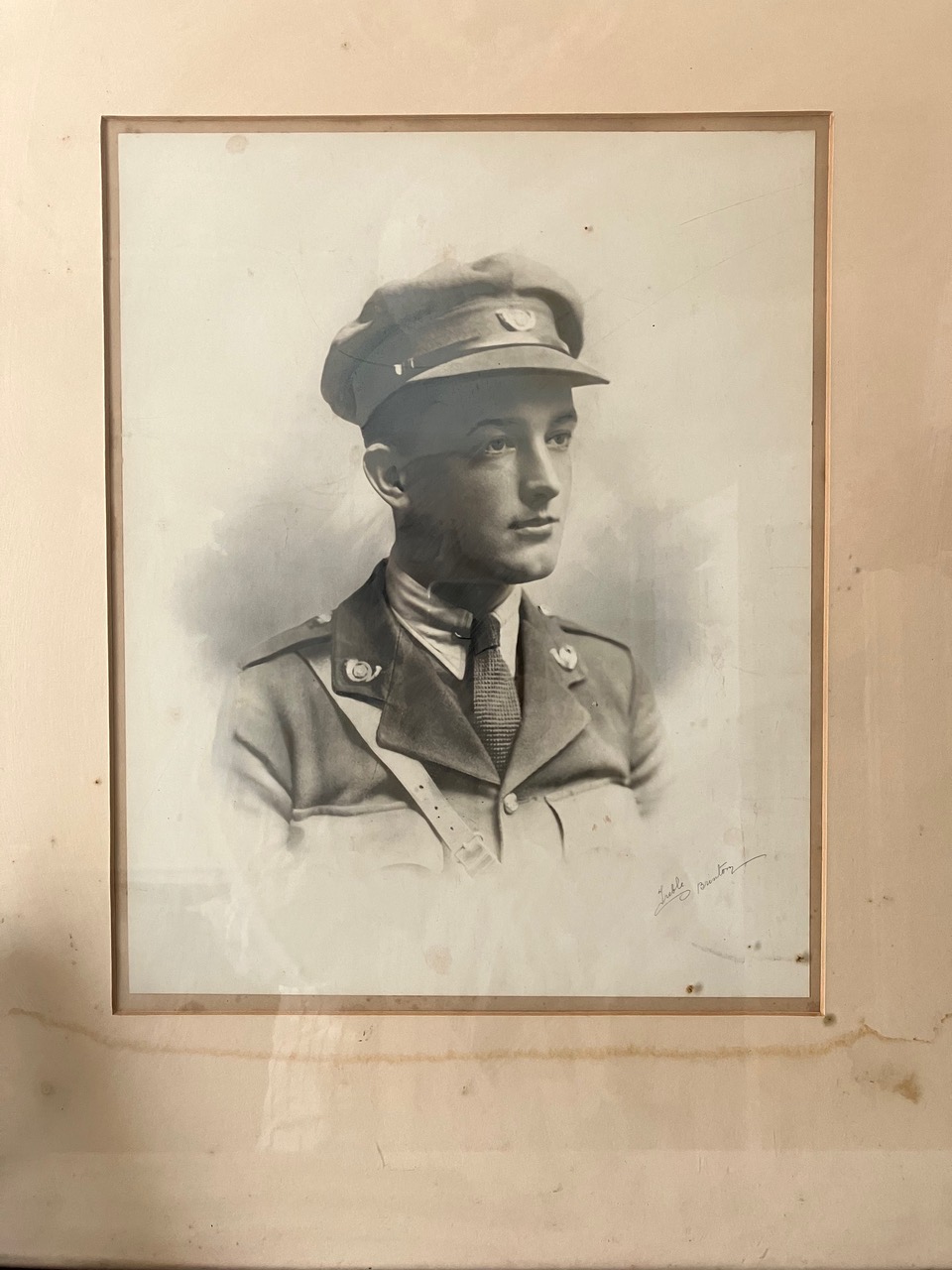
Frederick Gillard
F. Gillard
Second Lieutenant, King’s Own Yorkshire Light Infantry, 9th Battalion
Died age 20 on 24 August 1918
CWGC: “Only son of Frederick and Harriet Eliza Gillard, of 25 Studley Road, Clapham, London.”
Remembered Vis-en-Artois Memorial, France
Information from the 1911 census
The Gillard family lived at 48 Akerman Road where they occupied 5 rooms. Frederick Gillard, 41, was a lithographic printer, born in Blackfriars, London. Harriet Gillard (née Roberts), 34, was also from Blackfriars. Frederick Gillard, 12, their only son, was born in Kennington, as were their 3 daughters:
Amy Gillard, 10
Rose Gillard, 9
Florence Gillard, 7
There was a boarder, Christopher Wright, a single grocer’s assistant from Bermondsey, south-east London.
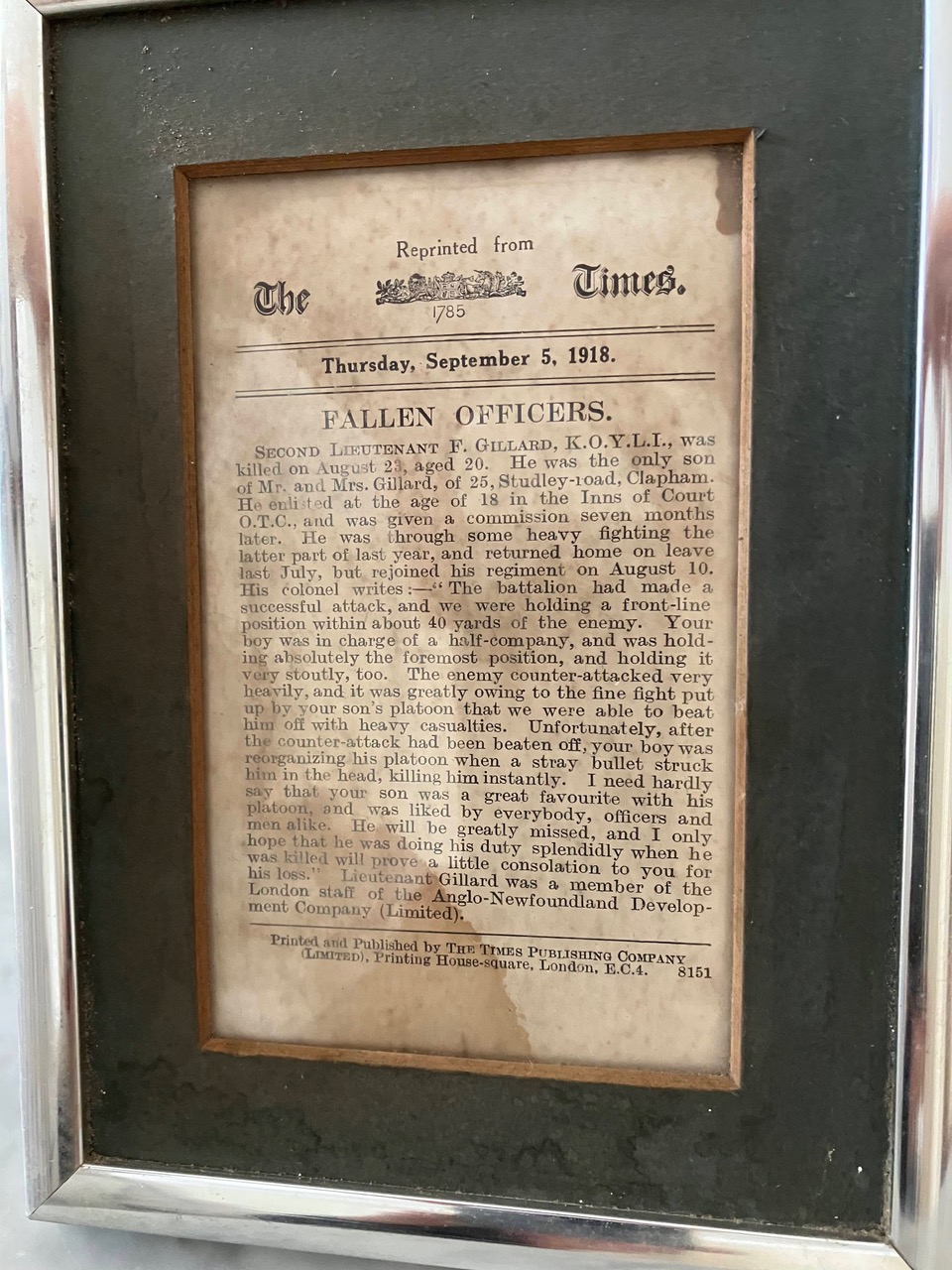
The obituary in The Times of 5 September 1918 reads:
SECOND LIEUTENANT F. GILLARD, K.O.Y.L.I. [King’s Own Yorkshire Light Infantry], was killed on August 23, aged 20. He was the only son of Mr. and Mrs Gillard of 25, Studley-road, Clapham. He enlisted at the age of 18 in the Inns of Court O.T.C. [Officers Training Corps], and was given a commission seven months later. He was through some heavy fighting the latter part of last year, and returned home on leave last July, but rejoined his regiment on August 10. His colonel writes:- “The battalion had made a successful attack, and we were holding a front-line position within about 40 yards of the enemy. Your boy was was in charge of a half-company, and was holding absolutely the foremost position, and holding it very stoutly, too. The enemy counter-attacked very heavily, and it was greatly owing to the fine fight put up by your son’s platoon that we were able to beat him off with heavy casualties. Unfortunately, after the counter-attack had been beaten off, your boy was reorganizing his platoon when a stray bullet struck him in the head, killing him instantly. I need hardly say that your boy was a great favourite with the platoon, and was liked by everybody, officers and men alike. He will be greatly missed, and I only hope that he was doing his duty splendidly when he was killed will prove a little consolation to you for your loss.” Lieutenant Gillard was a member of the staff of the Anglo-Newfoundland Development Company (Limited).
With thanks for additional information and images to Gwynn Jenkins, who came across the portrait and the framed obituary in the attic of her house in Forthbridge Road, Clapham. Gwynn says: ‘He has pride of place in my house and am happy for him to be included in your website for more to see and understand the tragic loss of such gallant young men – he’s a daily reminder of what sacrifice really means.’