• Skip to primary navigation
  • Skip to main content
  • Skip to footer
Stockwell War Memorial

Stockwell War Memorial

Friends of Stockwell War Memorial & Gardens

  • Home
  • Order the book (free download)
  • About
  • The men of Stockwell
  • History of the Memorial
  • Centenary Exhibition
  • Contact
  • Newsletter
  • Friends Group

SWM

1922: A poem written for the unveiling of Stockwell War Memorial

4 August 2015 by SWM

South London Press
11 May 1922

Stockwell’s Heroes
(Lines written in the garden of the Memorial Clock Tower unveiled last week)

Let all who seek this garden fair
A thought for Stockwell’s heroes spare,
The gallant lads who trod the road
Of sacrifice and bore the load
Of suffering for you and me
And generations yet to be!

Let all who gaze upon this tow’r
Whose timepiece marks the passing hour,
Reflect upon those fellows brave
Who found ‘neath battlefield their grave;
No need have they for hourly chimes,
Since they have travelled beyond Time.

Let Stockwell people, one and all,
Their fellow citizens recall,
Who, hand in hand with duty trod,
And through death’s gate have passed to God;
They laid their lives for others down,
And theirs in love’s eternal crown!

Let all who come for resting where
This clock is set in garden fair,
In fond remembrance turn to those
Who battled ‘gainst their country’s foes;
Beneath the Flag of Christ they stood,
Heroic types of young manhood!

CLAUDE GREENING
May, 1922

© South London Press

Filed Under: History of Stockwell War Memorial

1922: Stockwell’s heroic dead

4 August 2015 by SWM

This report of the unveiling and dedication was published in the Brixton Free Press on 5 May 1922


STOCKWELL’S HEROIC DEAD.
Royal Unveiling of Imposing Monument.
One of the Finest of London’s War Memorials.
That which, in its genesis, was to have been a worthy memorial to the brave men of Stockwell who made the supreme sacrifice on their country’s behalf in the Great War has, by the process, partly of postponement and partly of development, become a worthy memorial to the glorious dead of the entire borough.

During three years the Stockwell War Memorial Committee have been enthusiastically engaged in raising funds for a clock tower which a public meeting decided should be erected on the once derelict district eyesore known as the Triangle, situated at the important junction of Clapham Road, Stockwell Road and South Lambeth Road.

As time went on the idea was developed, and with the abandonment of the Borough Nursing Home, which at one time was suggested as a permanent memorial to Lambeth’s heroic dead, the Stockwell scheme became considerably enlarged, and further appeals were made to meet the increasing cost. The entire memorial scheme has involved an expenditure of roughly £5,000, and the result is a very imposing clock tower at the apex of the triangle, massive in proportions, and rising to a height giving dignity and importance to the erection. The clock itself is the generous gift of Dr. Caiger, of the South West London Hospital, one of the many parents from whom the irrevocable toll was exacted.

The site itself has been laid out as a public garden by the Lambeth Borough Council at a cost of something approaching £1,000, but in its completed state there can hardly be two opinions that the money on a [sic] public improvements in the borough was never better spent. The green turf, the smart trees, and the travelled paths have invested the site with a beauty which will be appreciated by the residents for generations to come, and adds to the utilitarian aspect of the memorial. In the laying out of the ground the Borough Engineer deserves great credit for the transformation he has been able to effect at this spot. Upon the chairman of the committee (Capt. Wallace M. Young), and the hon. secretary, Mr. Samuel Bowller, tremendous demands have been made, but in their efforts to reach the ideal which they set before themselves they had the unstinted co-operation of the whole of the members of the committee, and were able to rely upon a great deal of public support in raising funds, especially in what may be regarded as the more or less adventitious methods which had to be adopted during the winter months, when successful dances were held in aid of the funds.

The result of the memorial as it stands to-day is such as to remove any slight criticism which may still exist as to schemes undertaken to complete the memorial and to secure for the committee the unqualified approval of the entire borough.

Its Significance.

Shorn of the scaffolding, which has enclosed the clock tower for months past, and freed from the workmen and gardeners who have been engaged in laying out the site, the monument presents such an imposing appearance as to leave no doubt that the Stockwell Memorial is one of the finest public erections in London to those brave men whose great sacrifice can never be amply recognised.

As a monument, the clock tower raises its massive proportions in simple impressiveness and solemn dignity to a height of 45ft., and in appearance is no means unlike the Cenotaph in Whitehall, whose architect has gained the admiration of visitors from all parts of the world. But Stockwell’s column of stone possesses the advantage of housing a four-dial clock and the further advantage of standing within an open space accessible to the general public.

The successful architect, whose design was selected by Royal Academicians from a large number submitted, was Mr. Frank Dear, A.R.I. B.A., of John Street, Bedford Row, and the classical lines of Greek architecture form the basis of the design. On the main front appears the sculptured figure symbolical of “Remembrance,” which is the work of Mr. B. Clemens, of Chelsea. The figure is adorned with a laurel wreath, and at her feet is seen a broken sword. Beneath this figure appear the words, “To the Stockwell Men who Served in the Great War, 1914-1919.” Immediately below are two doors of teak, leading into the tower, and on a wall of this inner chamber, and visible through the door grilles, is a marble slab containing the names of the members of the committee, and the following inscription: “This monument was erected by subscriptions raised by the Committee of Stockwell residents, and presented together with the surrounding gardens, to the Lambeth Borough Council as a gift to the people for ever.” On the right, left, and back flanks of the tower are inscribed, at present, the names of 570 officers and men whose homes were within half a mile of the memorial and who made the great sacrifice. Above these names, on the right flank, are the appropriate words, “These were our sons who died for our lands,” and on the left flank the memorable phrase, “Their name liveth for evermore”; while on the back are the words, “In glory will they sleep and endless sanctity.”

The freehold of the land was obtained from the Ecclesiastical Commissioners through the kind services of Messrs. Clutton and conveyed to the Lambeth Borough Council inconsideration of an undertaking to maintain it as a garden in perpetuity. The contractor for the building was Mr. John F. Patrick, of Dalyell Road, Stockwell.

The Unveiling.

It seems a long time since the initial public meeting was held to discuss the Stockwell Memorial, when Sir Charles Gibbs presided, and addresses were delivered by Dr. Pearson, the Rev. Charles Spurgeon and others. But months and years of strenuous endeavour, sometimes in the face of critical hostility, were brought to happy fruition on Wednesday afternoon, when the unveiling and dedicatory ceremony was performed in the presence of an unprecedented concourse of people. Great eclat was given to the proceedings by the gracious presence of H.R.H. Princess Alice (Countess of Athlone), who unveiled the monument, and by the dedication of the same by the Lord Bishop of Kingston (The Right Rev. Dr. Herbert), who attended in the regrettable absence of His Grace the Archbishop of Canterbury, whose health has been somewhat uncertain of late, and who is this week presiding over the deliberations of the House of Convocation.

The weather was not quite so propitious as could have been desired, but happily during the actual ceremonial, rain, which fell in heavy showers before and after, held up, and the brief but impressive ceremony passed off without a hitch of any kind.

The Ceremony.

The sustained interest which the directors of the Stockwell Palladium have taken in the memorial scheme was further evidenced by their kindness in granting the use of their convenient theatre at the disposal of the civic guests as a robing room. The Mayor of Lambeth, wearing his official robes and chain of office, and accompanied by the mace bearer, was present in his capacity as chief citizen of the borough, and a large majority of the Aldermen and Councillors were likewise in attendance, wearing their robes.

Prior to the actual ceremony suitable music was played by the band of the “W” Division, Metropolitan Police, under the conductorship of Mr. Sylvester, and the choir of boys and girls from Spurgeon’s Orphanage near by, who were accommodated on a specially erected platform, sang “Thy will be done,” composed “in memory of our fallen heroes,” by Mr. Walter Partridge, the talented musical director of the Orphanage, under whose direction this very suitable item was rendered.

Punctually at 3 o’clock the Royal motor car arrived and the band played the National Anthem. Her Royal Highness, who was accompanied by her husband, the Earl of Athlone, was received by His Worship the Mayor, who had the honour of presenting to the Princess the following members of the Committee: Messrs. Wallace M. Young (chairman), Philip Bryman, Lennard Charles, Heaton C. Howard, David M. Jones, Henry King, James Mayo, William May Morgan, Sidney H. Stanley, Sidney Streeter, and Samuel Bowller (hon. secretary). A guard of honour was furnished by the East Surrey Regiment. The Princess was escorted to her place on a specially erected platform, facing the clock tower, still covered by a huge Union Jack. On the way Sir Charles H. Gibbs, Lambeth’s war-time Mayor, Mr. H. G. Purchase, M.P. (Kennington), and Councillors G. E. King and P. W. Willson had the honour of being presented to Her Royal Highness.

The ceremony proper commenced with the playing of Chopin’s Funeral March by the band of the “W” Division. With the Earl and Countess of Athlone on the platform were the Mayor, the Town Clerk (Mr. Bruce Penny), Capt. Wallace Young, Mr. Samuel Bowller, the Bishop of Kingston, the Revs. J. Smyth Wood and Henry Elkerton. The Princess was dressed in deep black, owing to the death of Lord Mountbatten, and carried a tightly rolled umbrella and a very neat handbag.

The opening sentences of the Burial Office were read by the Rev. J. Smyth Wood, of Trinity Presbyterian Church, Clapham Road. The immortal hymn, “O God, our Help in Ages Past” was sung by the vast crowd, and no better choice could have been made for the lesson, read by the Rev. Henry Elkerton, from the magnificent nine verses from the third chapter of the Book of Wisdom. These verses are so appropriate when we consider the great sacrifices made by men for a high national ideal, and the consolation is brought to many an aching heart by the assurance that “The souls of the righteous are in the hands of God, and there shall no torment touch them … Having been a little chastised they shall be greatly rewarded; for God proved them and found them worthy for Himself … Such as be faithful in love shall abide with Him; for grace and mercy is to His Saints, and He hath come for His elect.”

After this impressive reading the Stockwell Orphanage choir sang Sullivan’s “Homeland,” the children’s voices being heard to excellent effect.

The Speech Making.
Capt. Wallace Young (the chairman of the Memorial Committee) remarked that this day had long been looked forward to by the people of Stockwell. On this memorial were engraved some 570 names, but the committee, in spite of their energies could not expect to get a complete role [sic: roll]. This memorial had therefore been erected to the glorious memory of all men of Stockwell who returned not again. It was hoped that all passers by, who had some sorrowing recollections of the Great War, would take some comfort from the memorial erected to those who had made the supreme sacrifice. It was his privilege to ask Her Royal Highness to accept the committee’s best thanks for coming amongst them that afternoon, and he invited the Princess to graciously unveil the memorial.

The Princess stepped down from the platform and as she pulled the cords to release the Empire’s national flag she said, “To the glorious and lasting memory of the men of Stockwell who laid down their lives for their King and country.”

The Last Post and the Reveille were then sounded by two buglers of the East Surrey Regiment, after which the hymn, “For All the Saints” was sung to Barnby’s well-known tune.

At this point the memorial clock was set going, the hands pointing to 3.25pm.

The dedication of the memorial was by the Bishop of Kingston, whose admirable voice must have been heard by everyone in the great crowd. After the final dedication His Lordship commended to the mercy of God those who had fallen in the service of their country, and offered special prayers for wisdom and courage and that all might dedicate themselves anew to the service of Christ.”

Handing Over the Site.

Mr. Samuel Bowller, on behalf of the committee and subscribers, expressed the pleasure it gave him to ask His Worship the Mayor, as the chief representative of the Lambeth Borough Council, to accept the deeds of the garden site, together with the key of the monument, to hold for the perpetual use and benefit of the inhabitants of the borough.

The Mayor said he had very much pleasure indeed in accepting the deeds of the garden surrounding the memorial, particularly because the site had been for many years, though an open space, enclosed so far as the public were concerned. He rejoiced that this was now to be a public garden for ever, especially in view of the fact that upon it had been erected this very excellent memorial to the men of the Stockwell area of Lambeth who died during the Great War. Proceeding, His Worship exressed on behalf of the Borough Council and the people of Lambeth sincere and hearty thanks to Her Royal Highness for honouring them with her presence that day to unveil the memorial. As he had mentioned upon previous occasions, they were a very humble people in Lambeth, but he assured H.R.H. that they welcomed her sincerely for coming amongst them.

The Bishop then pronounced the Benediction, after which the Princess deposited at the base of the memorial a huge laurel wreath, tied with purple ribbons, and inscribed “Lest we Forget,” from the Stockwell War Memorial Executive Committee.

The playing of the National Anthem terminated the public portion of the ceremonial, and the Earl and Countess were shortly afterwards driven away, to the accompaniment of cordial cheers.

For a long time afterwards there was a continuous procession of people bearing floral tributes of affectionate remembrance of loved ones which were reverently placed at the base of the tower. Among the representative tributes were those from a “Few Stockwell boys,” from the Brixton and Kennington branch of the N.C.U. (deposited by Mr. F. J. Hortop), and from the Lambeth Division of the British Red Cross in the form of a cushion, deposited by Miss Breese, the divisional secretary.

The regulation of the huge throng was very efficiently discharged by a large body of police, mounted and on foot, while Mr. Dan Davies, commandant of the Lambeth British Red Cross Society was present, with a goodly number of members to render first aid in the event of necessity. Other public organisations represented were the Girls’ Life Brigade, in charge of Commandant Hookins, the Church Lads’ Brigade, and the Salvation Army G.L.B.

In the garden itself a number of commodious seats have been generously provided by various residents.

Useful work as steward during the time of the ceremony was done by Mr. A. Clarke.

Afterwards.

After the ceremony members of the committee and of the Borough Council, together with friends and guests, were generously entertained to tea by the directors of the Stockwell Palladium, in the York Restaurant. Here the Mayor of Lambeth took occasion to thank the directors of the theatre for their kind support to the memorial committee not only on that day but ever since the memorial was first decided upon. His Worship added that the memorial was indeed worthy of everybody’s support, and he expressed the earnest desire that the comparatively small balance still remaining would be speedily liquidated in order that the committee might be relieved of further financial burden.

Mr. Ellis Parker, chairman of the Palladium, acknowledged the compliment paid by the Mayor, and assured all that it was a pleasure to the directors to do anything they could for the people of Stockwell.

The Mayor thought that such a gathering on such an occasion should not close without a few words from him who had been for so many years and so honourably been associated with the municipal life of the borough, namely Sir Charles Gibbs.

Sir Charles, who was cordially received recalled the fact that it was his pleasure to preside at the first public meeting, when a Stockwell memorial was decided upon, and he commented on the great development of hte idea from that which was originally anticipated and added his plea tot hat of the Mayor, that the small balance remaining to complete the scheme would speedily be forthcoming.

Amongst those who wrote expressing their regret at being unable to attend Wednesday’s ceremonial was Sir Davison Dalziel, Brixton’s M.P.,who sent a further contribution of £5. Another gentleman whose absence was the cause for general regret was Dr. Pearson, who had identified himself so much with the progress of  the movement, and who regards the memorial in the light of the tomb of his own dear son. But Dr. Pearson felt that he could not bear the strain which the ordeal of unveiling and dedicating this memorial would impose upon him.

Thus stands, in all its imposing simplicity, a worthy memorial, not only to Stockwell’s unforgettable dead, but a monument which adds dignity to the public works of the borough, and is a crowning triumph to a vast amount of unremitting toil on the part of the committee inspired by the one desire that, as far as possible, the clock tower should worthily commemorate the self sacrifice of the flower of Stockwell’s manhood in the never to be forgotten Homeric struggle in the cause of Justice, Freedom and Humanity.

The following additional subscriptions to the fund have been received:-
£10, Mr. F. Surridge;
£5 5s. Mr. G. D. Howlett, Mr. W. P. Howlett, Mrs. Howlett, Mr. E. Muspratt;
£5 Messrs. Beaufoy and Co.;
£3 3s. Mr. S. J. Adams;
£2 2s. Mr. F. Budge, Mr. Larner, Mr. Stedman, Mr. S. A. Newman, Mr. David Williams, Mr. J. M. Cable;
£2 Rev. G. D. Barton Poole, Mrs. Trimmer;
£1 15s. Collection, Studley Road Chapel;
£1 12s. Mrs. Worley;
£1 11s. 6d. Mr. H. Kenyon Jeffes;
£1 10s. Mrs. Gayton, Mrs. L. M. Standley, Mr. Wm. Ogilvie;
£1 5s. Mrs. Honer;
£1 2s 6d. Mrs. Hobbs;
£1 1s. Mr. W. Percy, Mr. R. A. Reeve, Mrs. Reeve, Mr. W. Percy, Capt. Ridley, Mr. W. A. Smith, Mrs. Sore, Mr S. Papworth, Mrs. Bradban, Mr. A. E. Roberts, Mr. T. H. Wyatt, Mr. Wm. Downing, Mr. Arrowsmith, Miss Struthig, Messrs. Cornells Ltd., Mr Fred Corben, Mr. Percy Wilson, Messrs. Sydney Presbury and Co., Miss Hayward, Mr. S. J. Adams;
£1 Councillor T. S. Chatter, Miss N. F. Bailey, Mrs. Leach, Mr. Barnes, Mrs. A. Ashton, Rev. Monar Brown, Mrs. Barlow, Rev. Hy. Elkerton, Mrs. Nadaud, Major A. Ford-Young, Mrs. Spice, Mr. A. Cunningham, Mr. Walter Briant, Mrs. Candy, Mrs. Barlow, Mr. W. Wilson, Mrs. Norris, Rev. J. Smyth Wood, Mr. W. Keys;
15s. Mrs. Johnson, Mr. and Mrs. Porter
12s. 6d. Mr. E. Upton, Miss M. Odam;
11s. Mrs. E. E. Scott;
10s. 6d. Mr. A. J. Worthy, Miss Burdett, Mr. R. J. Jewell, Mr. A. C. Ardley, Mr. J. W. Sawyer, Mr. Councillor H. A. De Bourcier, Mr A. T Corkett, Mrs. E. F. Goldsworth, Mr. H. Attwood, Mrs. A. J. Alsopp, Mr. E. Hogg, Mr. Councillor T. S. Chutter, Mr. Pulsford;
10s. Mrs. Hart, Mrs. Shopland, Mrs. Nash, Mr. F. J. Farrell, Miss Bunn, Mrs. J. Tredwin, Mrs. Seymore, Mr. W. J. Hocking, Mrs. Barnes, Councillor Mrs. Hare, Mrs. Teakle, Mr. L. G. Smith, Mrs. Williams, Mr. A. Smith, Mrs. Meacock, Mrs. Smith, Mrs. Burmister, Mrs. Ridout, Mr. and Mrs. G. E. Noyes, Mr. W. Bird, Mr. H. J. Wild, Mrs. Gray, Mrs. L. Trace, Mrs. Fittall, Mrs. Collett, Mrs. Cutmore, Miss R. Verney, Mr. and Mrs. White, Mr. E. F. Hills, Mr. Councillor J. Fox-Davies, Miss E. Smith:
Total of amounts under 10s., £147 14s. 6d.

The Mayor’s appeal last week had realised £86 3s. 3d.

Filed Under: History of Stockwell War Memorial

1922: Stockwell War Memorial unveiling: the dramatic ceremony

4 August 2015 by SWM

Although the language is old-fashioned, this front-page report in the South London Press conveys something of the emotions of loss, regret and pride the local community felt in the years after the end of the war. The details – the women carrying “wreaths or little bunches of flowers, according to circumstances” – carry a poignancy even all these years later.

The afternoon of the unveiling ended with a terrific downpour, and this must have felt to many like the release of the unbearable tensions of the day.

Stockwell’s War Memorial is now largely ignored by the local population, although it provides a place for the most vulnerable and lost of society to sit during the day. But it should be remembered that this was once a place of spiritual and emotional power for Stockwellians, who, through the First World War, had suffered the greatest loss of life the world had ever known.


South London Press

Friday May 5, 1922

TO STOCKWELL MEN

Princess Alice Unveils Memorial to Over 500 Gallant Citizens

STRIKING CEREMONY BEFORE LARGE GATHERING.

Before a gathering of many thousands and with a ceremony worthy of the occasion, Stockwell War Memorial was unveiled on Wednesday by Princess Alice (Countess of Athlone). The memorial stands in a prominent position at the junction of South Lambeth-rd. and Clapham-rd., and for some hours before the ceremony was announced to take place the large open space surrounding the garden site, upon which the memorial tower has been erected, was thronged with a densely packed crowd. In its way, it was a unique ceremony, and the interest could hardly have been surpassed has it been a national instead of local affair. Among the onlookers were many ex-Service men and women wearing medals and decorations, and a large number of women in mourning, carrying wreaths or little bunches of flowers, according to circumstances, to place at the foot of the memorial in honour of their fallen. This spontaneous appreciation on the part of so many thousands came as a fitting tribute to the perseverence and endeavour, in the face of many difficulties and set-backs, on the part of the committee.

SOLEMN HUSH.

Not only were the streets packed, but from railings, surrounding windows and house-tops, and other points of vantage, eager spectators watched the unveiling. The solemnity of the occasion was well remembered, and standing in the centre during the actual ceremony, everywhere was so hushed and quiet that it was hard to realise, without looking round, that masses of men, women and children were closing in on all sides. Occasionally a tram would clank its way through, but even these paused, as faintly at first, but swelling into one great chorus, the words of the hymn, “Oh God, our Help in Ages Past” were caught up by the waiting hundreds. Amid the same reverent silence came with marked distinctness the words of prayer and benediction pronounced in solemn and impressive tones.

Princess Alice was accompanied by the Earl of Athlone, and was met by the Mayor of Lambeth (Councillor W. S. Bishop), who attended with the aldermen and members of the borough council, all wearing their robes of office. As the Princess drove up, a guard of honour, composed of a detachment of the East Surrey Regiment, under Capt. Bayliss, received her with a royal salute, the guard presenting arms and the band playing the National Anthem. Their Highnesses inspected the guard of honour with the Mayor, who afterwards presented the aldermen and members of the council to them. Ona small platform erected in front of the memorial were the Countess and Earl of Athlone, the Bishop of Kingston (Rt. Rev. P. M. Herbert), the Mayor, the Town Clerk, Rev. J. Smyth Wood (Trinity Presbyterian Church, Clapham-rd.), Rev. H. Elkerton (St. John, Clapham-rd.), Capt. W. M. Young, M.B.E. (chairman Memorial Committee), and Mr. Samuel Bowller (hon. secretary). Inside the enclosure were the members of the borough council and their ladies, Mr. H. G. Purchase, M.P. (Kennington), and representative municipal and local men and women, together with a large number of subscribers. At the far end were the choir of boys and girls from Stockwell (Spurgeon’s) Orphanage, and the band of “W” Division Metropolitan Police. Detachments of the British Red Cross (Lambeth division), under Miss Breese, Church Lads’ Brigade and Girls’ Life Brigade were also present. Besides the chairman and secretary, the committee consisted of Messrs. P. Bryman, L. Charles, H. C. Howard, D. M. Jones, H. King, J. Mayo, W. M. Morgan, H. W. Norman, S. H. Stanley, and S. Streeter.

The ceremony opened with the singing of “Thy Will be Done” (W. Partridge) by the Orphanage Choir, and the playing, as the assembly stood bare-headed, of Chopin’s “Marche Funebre” by the “W” Division band. Impressively and solemnly, Rev. J. Smyth Wood then read the opening sentences, the first in the burial service; that, alas, in these days so familiar epitaph. “Greater love hath no man than this, that a man lay down his life for his friends”; and then those words of mingled pride and comfort, “Their bodies are buried in peace, but their name liveth for evermore.” One of hte most affecting parts of the whole ceremony was the singing, led by the choir of children’s voices, of “Oh God, our Help in Ages Past,” when save for the melody of the hymn, all round was hushed – and echo of an unforgettable incident during the unveiling of the Cenotaph in Whitehall two years ago,. Standing at the foot of the platform, facing the monument and people, Rev. H. Elderton read out the first nine verses of the third chapter of Wisdom, that striking epitome of the hope and solace which comes from faith.

“TO THE MEN OF STOCKWELL.”

Captain Young, as chairman of the Memorial Committee, invited Princess Alice to unveil the memorial. It was a day, he said, long looked forward to by the people of Stockwell. On the memorial were engraved some 560 names, but he committee recognised in spite of their energies, they could not expect to have compiled a complete roll. The memorial was, therefore, erected to the glorious memory of the men of Stockwell who returned not again. It was hoped that, directed with such a purpose, the memorial might be a source of comfort to all passers-by who had sorrowing recollections of the Great War. It was his privilege, added Capt. Young, to ask Her Royal Highness to accepted their best thanks for consenting to perform the unveiling.

Stepping down fromthe platform, Princess Alice released the Union Jack covering the face of the memorial, and so unveiled it with the simple words: “To the glorious and lasting memory of the men of Stockwell, who laid down their lives for their King and Country.” Breaking the silence which followed, rang out the notes of the “Last Post,” sounded by buglers of the East Surrey Regiment, followed by the “Rouse.” The clock in the tower was at the same time set going. “For all the Saints” followed, and then the dedication by the Bishop of Kingston.

Mr. Samuel Bowller, on behalf of the committee and subscribers to the memorial fund, formally presented the Mayor the deeds of the garden site, and the key of the memorial tower, to be held in perpetuity for the inhabitants of the borough.

The Mayor said he had very much pleasure in formally accepting the deeds of the memorial and garden site surrounding it, particularly as for many years it had been an unbuilt-on space, but more or less enclosed as far as the public was concerned. He was glad that now it would be open to the public for ever, especially as it had erected upon it such an excellent memorial to the men of Stockwell. Expressing his thanks on behalf of the borough to the Earl and Countess of Athlone, the Mayor said that they were very humble people, but they did heartily thank the Earl and Countess, and extend to them cordial welcome.

STRIKING FLORAL TRIBUTES.

A wreath from the executive committee was placed at the foot of the tower by Princess Alice, and the ceremony concluded with the Benediction by the Bishop and the National Anthem. Many beautiful wreaths, including one striking tribute from a “Few old Stockwell Boys,” and another from the Brixton and Kennington branch of the National Citizens’ Union, were afterwards laid around the base of the memorial. For some time, a constant stream of people passed round the memorial, some scanning the names for that of one belonging to them, others placing wreaths and flowers, until the storm which had threatened all the afternooon, but fortunately had held off during the actual ceremony, burst, and dispersed the crowd.

Selected by the War Memorials Committee of Royal Academicians from designs submitted by forty British architects, the memorial takes the form of a cenotaph-shaped tower, terraced and with steps leading up to the base. It is forty-five feet high, built of Portland stone, and displays a four-dials clock. On the font, above the door, is a figure symbolical of “Remembrance,” and the carved inscription: “To the Stockwell men who served in the Great War, 1914-1919.” On a wall of the camber and visible through the door grille, is a marble slab inscribed with the names of the members of the committee. The five hundred and seventy names are those of men whose homes were within half a mile of the memorial, the freehold of which was acquired by the committee and conveyed to the borough council, has been laid out as a public garden by the council and will be retained as such by them.

© South London Press

Filed Under: History of Stockwell War Memorial

1922: Stockwell War Memorial unveiling – an appeal

4 August 2015 by SWM

This account was published in the South London Press shortly before the opening of the Stockwell War Memorial in May 1922.


28 April 1922
STOCKWELL MEMORIAL.

Arrangements for Unveilling and Dedication of Princess Alice (Countess of Athlone).

NEXT WEDNESDAY’S CEREMONY.

The Stockwell War Memorial, which has beeen erected at the junction of South Lambeth and Clapham Roads, will be unveiled next Wednesday by Princess Alice (Countess of Athlone), and dedicated by the Bishop of Kingston.

The memorial, which stands on a most conspicuous site, has led to the carrying out of a fine public improvement on the small island area. In addition to the cenotaph-shaped tower with clock, the ground at the rear has been laid out and will form a restful resort for the public. The local committee, of which Mr. Samuel Bowller, of 232, Clapham-rd, is hon. secretary, has applied itself to the task with commendable vigour, and the result is not only a useful public improvement, but a worthy memorial to the sons of Stockwell who fell in the Great War.

Next Wednesday’s ceremony will begin at three o’clock, but half-an-hour earlier the band of the “W” Division of police will play. The actual ceremony will be proceded by singing of suitable pieces by the Stockwell (Spurgeon’s) Orphanage Choir. Afterwards the buglers of the East Surrey Regiment will sound the “Last Post,” followed by the Reveille. The dedication ceremony is to be performed by the Bishop of Kingston, and an address will be given by the Mayor of Lambeth (Councillor W. S. Bishop). Towards the close of the ceremony, Mr. Samuel Bowller, the hon. secretary of the Memorial Committee, will formally offer the garden site and the monument to the Mayor of Lambeth, to hold for the people for ever.

MORE FUNDS WANTED.

The present Mayor of Lambeth (Councillor W. S. Bishop) and his three predecessors in office (Messrs. F. Budge, James Williams, and Sir Chas. G. Gibbs) have issued an appeal in which they claim that this memorial is such as will bear favourable comparison with any in South London; indeed, it would be difficult to find one so suitable in every respect and in such a commanding position. It undoubtedly reflects credit on the very energetic committee responsible for its erection. Up to date the major portion of its cost has been met, but there remains a balance of about £600 to be raised, and it is the desire of the committee that on the unveilling and dedication it should be possible to announce that the whole cost has been met and the structure free from debt. The committee therefore earnestly commend to Lambethans this appeal, and trust that the hope of the committee will be fulfilled. To this end, contributions will be thankfully received by the signatories address to the Town Hall, Brixton-hill, S.W.2, or to the hon. secretary, Mr. S. Bowller, 232, Clapham-rd.

© South London Press

Filed Under: History of Stockwell War Memorial

1922: Dr. Foord Caiger gives the clock in memory of his only child

4 August 2015 by SWM

doctors gift

Dr. Foord Caiger, whose son Frederick Caiger died on 11 November 1916, donated the clock on the memorial tower. The following report appeared in the South London Press on 22 February 1922


SOUTH LONDON PRESS
22 February 1922

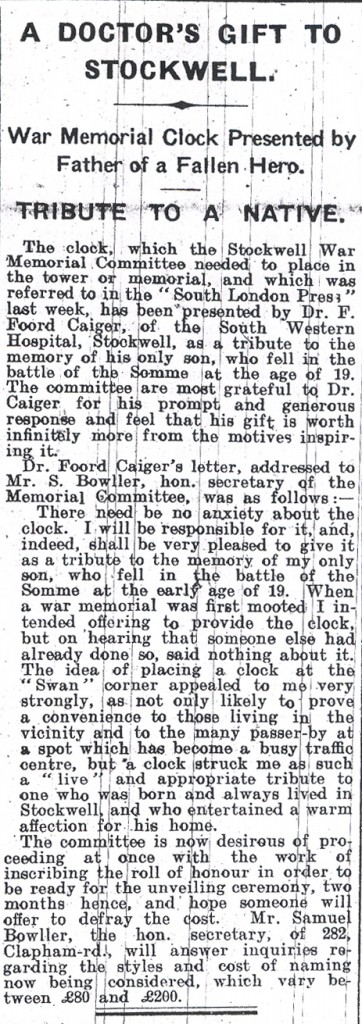
A DOCTOR’S GIFT TO STOCKWELL.
War Memorial Clock Presented by Father of a Fallen Hero.
TRIBUTE TO A NATIVE.
The clock, which the Stockwell War Memorial Committee needed to place in the tower or memorial, and which was referred to in the “South London Press” last week, has been presented by Dr. F. Foord Caiger, of the South Western Hospital, Stockwell, as a tribute to the memory of his only son, who fell in the battle of the Somme at the age of 19. The committee are most grateful to Dr. Caiger for his prompt and generous response and feel that his gift is worth infinitely more from the motives inspiring it.

Dr. Foord Caiger’s letter, addressed to Mr. S. Bowller, hon. secretary of the Memorial Committee, was as follows:-

There need be no anxiety about the clock. I will be responsible for it, and indeed, shall be very pleased to give it as a tribute to the memory of my only son, who fell in the battle of the Somme at the early age of 19. When a war memorial was first mooted I intended offering to provide the clock, but on hearing that someone else had already done so, said nothing about it. The idea of placing a clock at the “Swan” corner appealed to me very strongly, as not only likely to prove a convenience to those living in the vicinity and to the many passers-by at a spot which has become a busy traffic centre, but a clock struck me as such a “live” and appropriate tribute to one who was born and always lived in Stockwell, and who entertained a warm affection for his home.

The committee is now desirous of proceeding at once with the work of inscribing the roll of honour in order to be ready for the unveiling ceremony, two months hence, and hope someone will offer to defray the cost. Mr. Samuel Bowller, the hon. secretary, of 282, Clapham-rd., will answer inquiries regarding the styles and cost of naming now being considered, which vary between £80 and £200.

Filed Under: History of Stockwell War Memorial

1921: Metropolitan Police assist the fund-raising effort

4 August 2015 by SWM

© South London Press

On 1 July 1921 the South London Press reported on a recent fund-raising during which they presented a minstrel show. Much frowned on now, at that time, minstrels shows, in which performers appeared in evening dress and blackface and sang negro spirituals and popular ballads, were regarded as perfectly acceptable forms of entertainment.

The Police Minstrels were founded in 1872 and raised £250,000 for police charities. They were disbanded in 1932.

The “W” division of the Metropolitan Police played at the unveiling and dedication of the memorial in May 1922.

The South London Press report is given verbatim.


SOUTH LONDON PRESS
1 July 1921

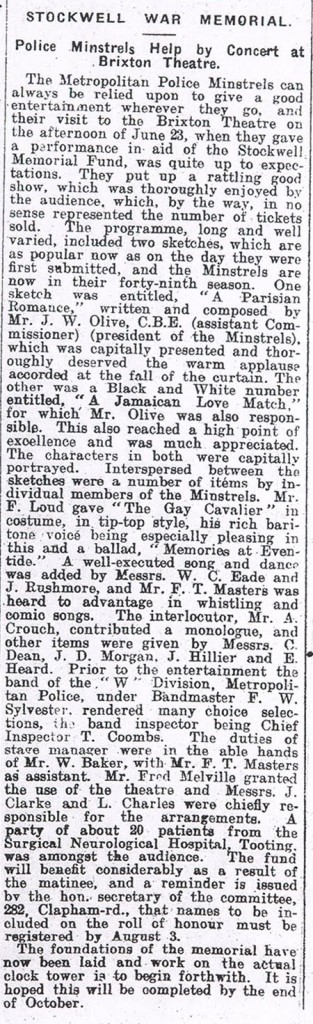
STOCKWELL WAR MEMORIAL.
Police Minstrels Help by Concert at Brixton Theatre.
The Metropolitan Police Minstrels can always be relied upon to give a good entertainment wherever they go and their visit to the Brixton Theatre on the afternoon of June 23, when they gave a performance in aid of the Stockwell Memorial Fund, was quite up to expectations. They put up a rattling good show which was thoroughly enjoyed by the audience, which, by the way, in no sense represented the number of tickets sold. The programme, long and well varied, included two sketches, which are as popular now as on the day they were first submitted, and the Minstrels are now in their forty-ninth season. One sketch was entitled “A Parisian Romance,” written and composed by Mr. J. W. Olive, C.B.E. (assistant Commissioner) (president of the Minstrels), which was capitally presented and thoroughly deserved the warm applause accorded at the fall of the curtain. The other was a Black and White number entitled, “A Jamaican Love Match,” for which Mr. Olive was also responsible. This also reached a high point of excellence and was much appreciated. The characters in both were capitally portrayed. Interspersed between the sketches were a number of items by individual members of the Minstrels. Mr. F. Loud gave “The Gay Cavalier” in costume, in tip-top style, his rich baritone voice being especially pleasing in this and a ballad, “Memories at Eventide.” A well-executed song and dance was added by Messrs. W. C. Eade and J. Rushmore, and Mr. F. T. Masters was heard to advantage in whistling and comic songs. The interlocutor, Mr. A. Crouch, contributed a monologue and other items were given by Messrs. C. Dean, J. D. Morgan, J. Hillier and E. Heard. Prior to the enertainment the band of the “W” Division, Metropolitan Police, under Bandmaster F. W. Sylvester, rendered many choice selections, the band inspector being Chief Inspector T. Coombs. The duties of the stage manager were in the able hands of Mr. W. Baker, with Mr. F. T. Masters as assistant. Mr. Fred Melville granted the use of the theatre and Messrs. J. Clarke and L. Charles were chiefly responsible for the arrangements. A party of about 20 patients from the Surgical Neurological Hospital, Tooting, was amongst the audience. The fund will benefit considerably as a result of the matinee, and a reminder is issued by the hon. secretary of the committee, 282, Clapham-rd., that names to be included on the roll of honour must be registered by August 3.

The foundations of the memorial have now been laid and work on the actual clock tower is to begin forthwith. It is hoped that this will be completed by the end of October.

Filed Under: History of Stockwell War Memorial

  • « Go to Previous Page
  • Page 1
  • Interim pages omitted …
  • Page 94
  • Page 95
  • Page 96
  • Page 97
  • Page 98
  • Interim pages omitted …
  • Page 100
  • Go to Next Page »

Footer

The Men of Stockwell

  • All the men
  • Died on 1 July 1916
  • Brothers
  • Listed on St Mark’s War Memorial
  • Listed on St Andrew’s War Memorial
  • Listed on St John’s War Memorial

SEARCH THE SITE

Other local memorials

  • St Mark’s, Kennington
  • St Andrew’s, Landor Road
  • St Michael’s Church shrine
  • Wynne Road sorting office
  • Brixton Town Hall
  • St John’s Church
  • Michael Church, Myatts Fields
  • St Mark’s War Shrine
  • St Anne’s War Crucifix
  • Clapham War Memorials

About this site

This site lists 574 men named on Stockwell War Memorial in London SW9.

If you would like to contribute information or images to the site, please email stockwellmemorialfriends@gmail.com

Copyright © 2025 · Genesis Sample On Genesis Framework · WordPress · Log in

  • All the men
  • Died on 1 July 1916
  • Brothers
  • Listed on St Mark’s War Memorial
  • Listed on St Andrew’s War Memorial
  • Listed on St John’s War Memorial